
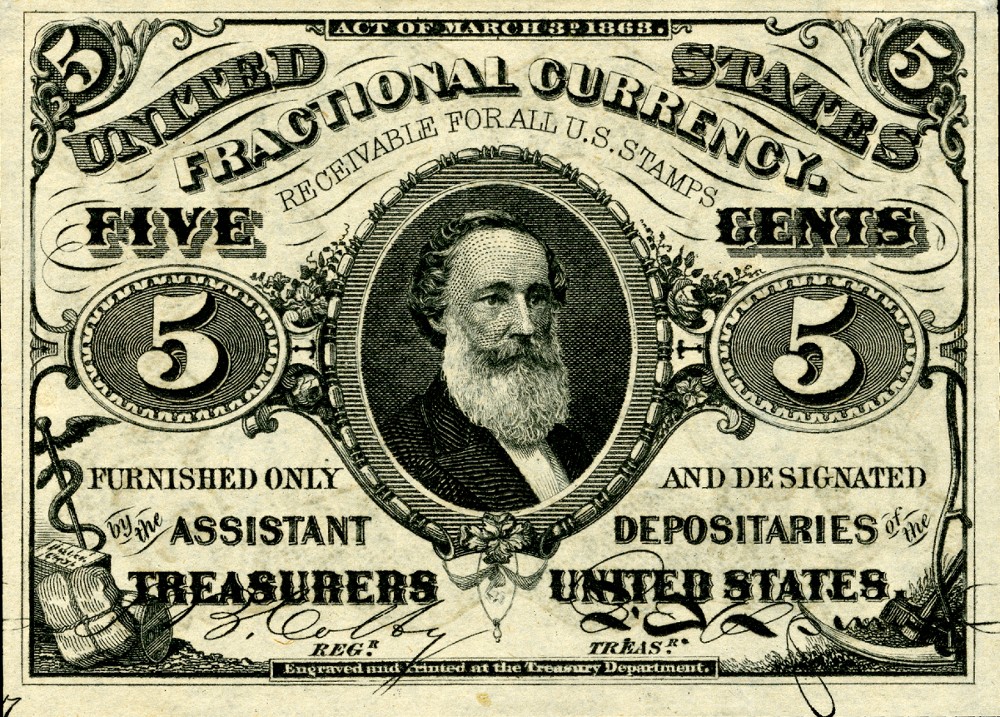
Today is National Dollar Day, so it’s a good time to talk about the time a guy overseeing the printing of US money decided the best person to feature on that money was… himself.
He was Spencer M. Clark, Superintendent of the National Currency Bureau.
That’s known today as the Bureau of Engraving and Printing.
Clark’s innovations helped the government print currency quickly and more efficiently.
But he was not always the most popular guy in Washington DC.
As Atlas Obscura reported, he had been also investigated for overseeing – and this is a direct quote – “gross immorality” at the Treasury Department!?!
The investigation cleared him, but whatever parts of his reputation he regained after that probe, he lost a couple years later.
At this time the US was short on coins, so it issued paper money to represent what in our time would be nickels, dimes, quarters and half-dollars.
There are a couple stories about the five cent bill, and in each version there’s a key loophole.
Here’s the most famous version: supposedly Congress wanted the new version of the bill to feature William Clark, of Lewis and Clark fame.
But somehow the paperwork only said to feature “Clark.”
And though everyone knew which Clark they meant, Spencer M. Clark decided that Spencer M. Clark should be the Clark on the money instead.
There could be another less scandalous explanation.
Clark was the one who suggested having the signatures of top officials on paper money.
And around this same time the 50 cent bill featured Treasury Secretary Francis Spinner.
So maybe he figured putting treasury officials on money, including himself, could help foil counterfeiters?
No matter the reason, lawmakers were furious to learn that a five cent bill that had once featured George Washington himself now featured Spencer M. Clark.
They eventually passed a law that said no living person can be featured on any US money, even if their last name was Clark.
It’s International Cat Day.
There’s a 19 foot long fiberglass cat in Pine Island, New York.
Originally it was part of a float in the Macy’s Thanksgiving Day Parade.
After that it was destined for the dump, until a guy saved it and it’s lived on at a number of spots, mostly in New Jersey.
With a backstory like that, no surprise that it was originally named Lucky.
A Treasury Official in 1866 Put His Own Face on U.S. Currency (Atlas Obscura)
The Biggest Cat In The World (WeirdNJ via YouTube)
For just 20 Spencer M. Clark bills a month (aka $1), you can back this show on Patreon