

In the US our main coins are the penny, the nickel, the dime, the quarter and the half dollar.
Around this time in 1935, the US government was making a big decision about some small amounts of money: there was a push to create a kind of currency worth a tenth of a cent.
The idea didn’t come out of nowhere.
If you look at the Coinage Act of 1792, which spells out what a dollar is, you’ll find a provision that says one-hundredth of a dollar shall be known as the cent and one-thousandth of a dollar shall be known as a mill.
The penny was adequate for most needs in the 18th and 19th centuries so they didn’t mint any mills.
But the idea came back up in the 20th Century, thanks largely to the Great Depression.
A lot of states established sales taxes to generate new public revenue, which turned out to be tricky for a lot of shop owners.
Say your state had a 2 percent sales tax.
If you bought a car for, say, $500, the sales tax works out to be a very straightforward ten bucks.
But if you were buying, say, a loaf of bread for nine cents, the sales tax works out to 18 thousandths of a dollar.
There was no coin to pay those taxes.
The problem came up again later when the government set the federal gas at 1.5 cents per gallon.
In that very economically challenging time, people didn’t want to just round up and give away money.
Some states decided to create their own sales tax tokens or coupons, worth one-tenth or a cent or sometimes a half a cent.
But those weren’t strictly legal, since only the federal government was supposed to be able to create money.
President Franklin Roosevelt’s administration proposed issuing 1 mill and 5 mill pieces, but the idea didn’t go far in Congress.
It turned out that it would cost the federal government a lot of money to make coins worth very little money to solve what they saw as a state problem.
By the end of the 1930s most states had done away with their sales tax tokens.
The rest went away during World War II, when Americans had to deal with an even more complex system: ration books.
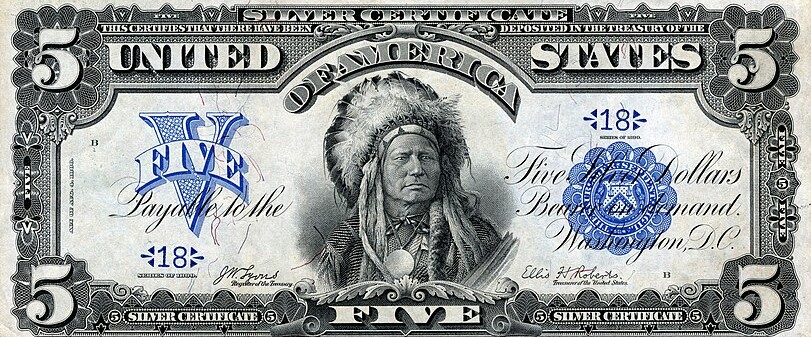
This week in 1886, Congress authorized the printing of a five dollar silver certificate.
The version of the certificate issued in 1899 featured the likeness of Tȟatȟóka Íŋyaŋke, a Hunkpapa Lakota chief also known as Running Antelope.
He is, as of now, the only Native American to appear on US money.
What are Sales Tax Tokens? (Taxtoken.org)
Running Antelope and the 1899 $5 Silver Certificate (Coin Week)
With just a little money each month on Patreon, you can make this show happen
Sales tax tokens image by $1LENCE D00600D at English Wikipedia, CC BY-SA 3.0
Silver certificate image from the National Numismatic Collection at the Smithsonian Institution, via Wikicommons


